Physical Address
304 North Cardinal St.
Dorchester Center, MA 02124
Physical Address
304 North Cardinal St.
Dorchester Center, MA 02124

Last spring, I was laying out foundation footings for a 16-by-24-foot workshop addition behind my house. The site slopes about 18 inches front to back, and I needed a level reference that could hold up across that distance without me running string lines every ten feet. My old red laser could barely reach 200 feet in direct sun, so I started looking for something with more range. That search led me to spend several weeks with the product you are reading about in this Klein Tools 93RLS review. I used it for grading, setting concrete forms, and aligning overhead joists across the full span of the build. This Klein Tools 93RLS review and rating reflects real conditions: sun, dust, vibration, and continuous operation across multiple days. I cover what worked, what did not, and whether this kit justifies its price tag for someone who needs a serious rotary laser.
Transparency note: This review contains affiliate links. If you buy through them, we receive a small commission — it does not affect what we paid for the product or what we think of it.
At a Glance: Klein Tools 93RLS Green Self-Leveling Rotary Laser Level Kit
| Tested for | Five weeks on a workshop addition project — foundation layout, concrete forming, framing, and ceiling alignment. Mixed indoor and outdoor conditions including direct sun and light rain. |
| Price at review | 699.98USD |
| Best suited for | Experienced contractors and serious DIYers who need a reliable rotary laser for outdoor grading, concrete work, and large-scale framing projects where range matters. |
| Not suited for | Occasional weekend warriors who primarily do indoor shelving or small remodeling — a cross-line laser at half the price would meet those needs without the complexity. |
| Strongest point | The detector extends usable range well beyond what the naked eye can see in daylight. At 300 feet with the detector, the signal remained clear and consistent without false positives. |
| Biggest limitation | The tripod included in the kit is functional but noticeably less rigid than a survey-grade tripod. In windy conditions or on soft ground, it introduces wobble that undermines the laser’s precision at distance. |
| Verdict | Worth buying if you need a full kit with detector, rod, and tripod for outdoor work at range. Not the best choice if you already own a good tripod and detector — the bare laser unit offers better value elsewhere. |
Rotary laser levels sit at the intersection of precision layout tools and construction-grade equipment. They are the workhorses for anyone who needs a level reference over long distances — foundation contractors, concrete crews, large-scale framers, and site preparers. A handheld bubble level cannot cover a 100-foot run. A cross-line laser tops out around 50 to 80 feet before the beam becomes too diffuse to read. A rotary laser, spinning a beam in a full 360-degree plane, solves that range problem.
The Klein Tools 93RLS falls into the mid-to-premium tier of this category. At roughly 700 dollars for the full kit, it competes with offerings from DeWalt, Bosch, and Johnson Level. You can find entry-level rotary lasers for under 300 dollars, but they typically use red diodes, have shorter range, and include fewer accessories. You can also spend over 1,500 dollars on a top-shelf unit with dual-slope capability and remote control. This Klein sits in the middle: green diode for better visibility, full kit with detector and rod, but no slope functionality. That trade-off makes sense for a specific buyer — someone who needs range and durability but does not require grading capabilities.
Klein Tools has been in the hand tool and testing equipment business for over 160 years. Among electricians and tradespeople, the brand carries genuine weight. Their reputation rests on durable, field-tested products that do not cut corners on materials. That reputation is why many experienced users will look at this Klein Tools 93RLS review pros cons analysis before making a purchase decision. The company is not new to lasers — they have been producing them for years — but this model represents their push into the full-kit rotary space with a green diode. Klein Tools’ official product page positions it as a jobsite-ready solution, and the IP66 rating backs that claim with concrete data rather than vague marketing.
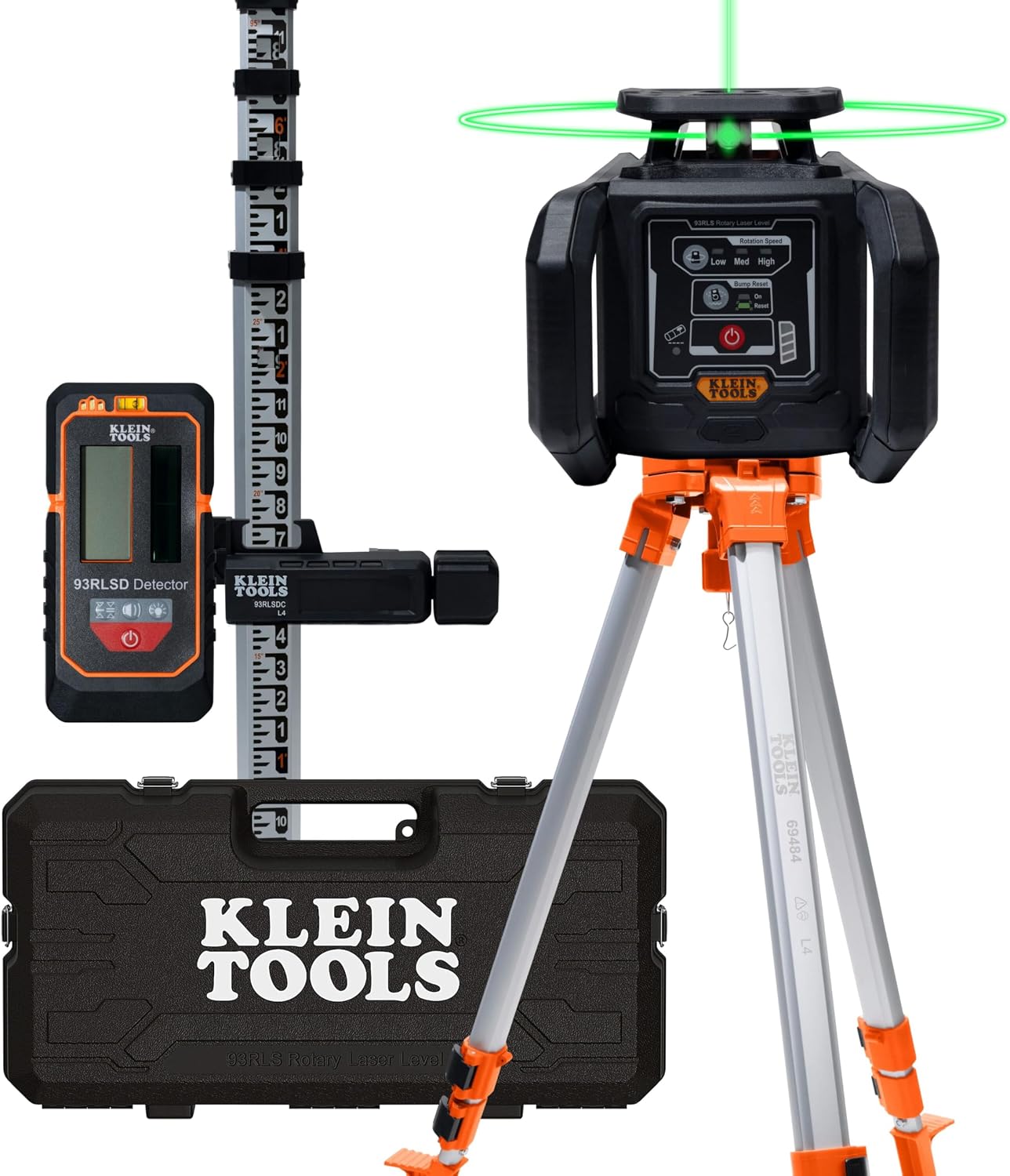
The box is large and heavy — about 18 by 14 by 10 inches — and the carrying case inside is the molded, foam-lined type with a hard plastic shell. That case alone suggests this product was designed for people who throw equipment into truck beds. Everything fits in cutouts: the laser head, detector, detector mount, grade rod sections, tripod, charging cable, and a small pouch with the manual and quick-start guide.
The laser head weighs 4.36 pounds and the metal housing has a knurled, powder-coated finish. It does not feel delicate. The orange accent color is not cosmetic — it makes the unit easier to spot on a cluttered jobsite or in the case. The tripod extends to about 60 inches and has 5/8-inch mounting threads, which is the standard survey thread. A nice detail: the mount plate has a bubble vial on top so you can rough-level before powering on the self-leveling feature.
What is missing from the box: alkaline batteries. The unit uses a rechargeable pack, so you get a USB-C charging cable but no wall adapter. Most people have one, but if you are buying this for a jobsite that lacks USB ports, you will need to purchase a 5V adapter separately. Also absent: any kind of remote control or Bluetooth module. That is not a deal-breaker at this price point, but it is worth noting for anyone used to adjusting lasers without walking back to the unit.
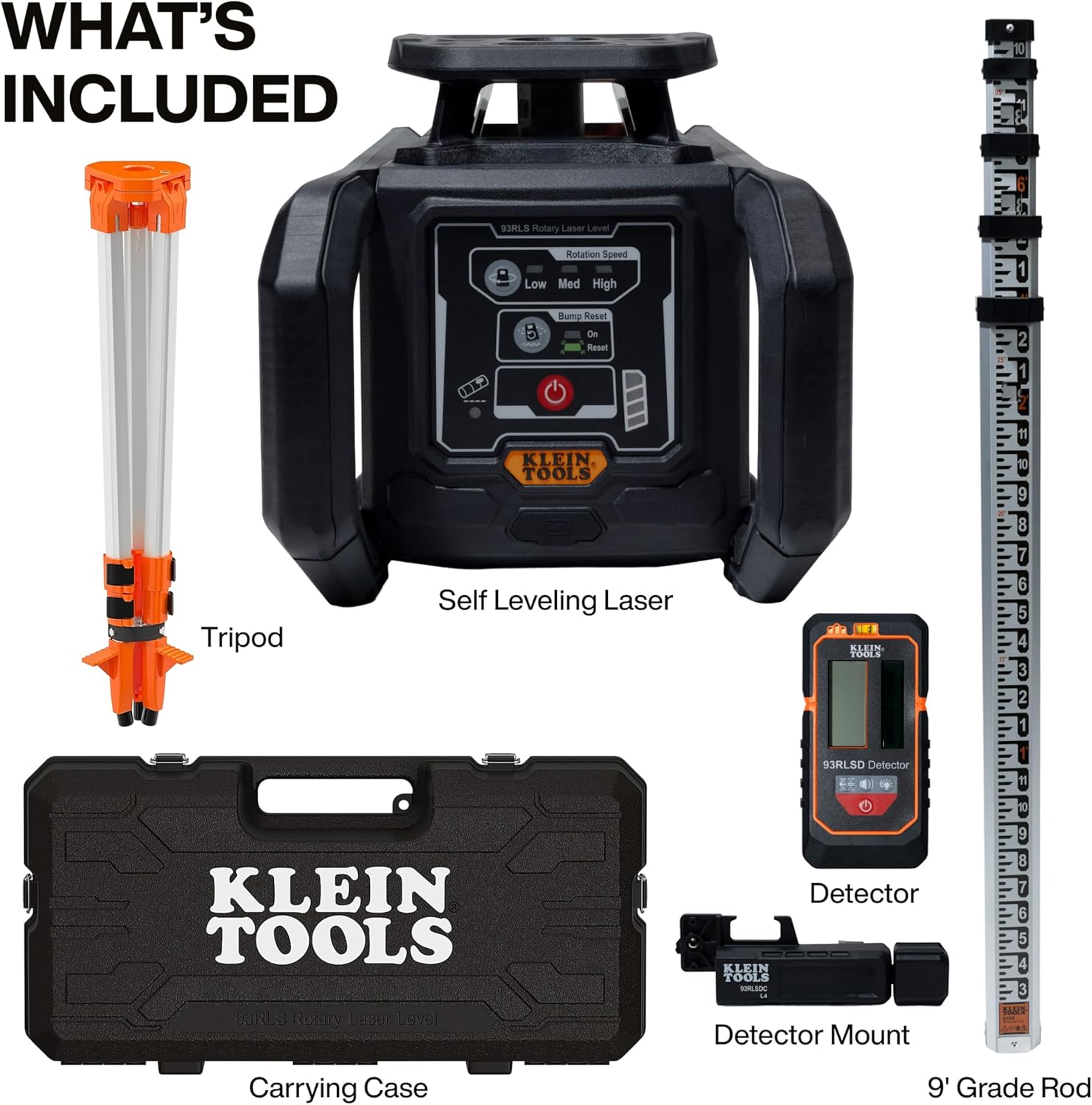
I unpacked the kit on a Tuesday morning, charged the laser head for about two hours until the indicator light turned green, and took it outside. The manual is short — 16 pages with diagrams — and the quick-start guide covers the essentials: power on, let it self-level, use the detector for long distances. Setup from unboxing to first measurement took about 12 minutes, including mounting the detector on the grade rod and attaching the laser to the tripod. The self-leveling locked in within about 15 seconds on a slightly uneven surface. The green beam was clearly visible in shade at about 150 feet. In direct sunlight, the beam became faint past 80 feet, but the detector picked it up reliably at 200 feet on the first try.
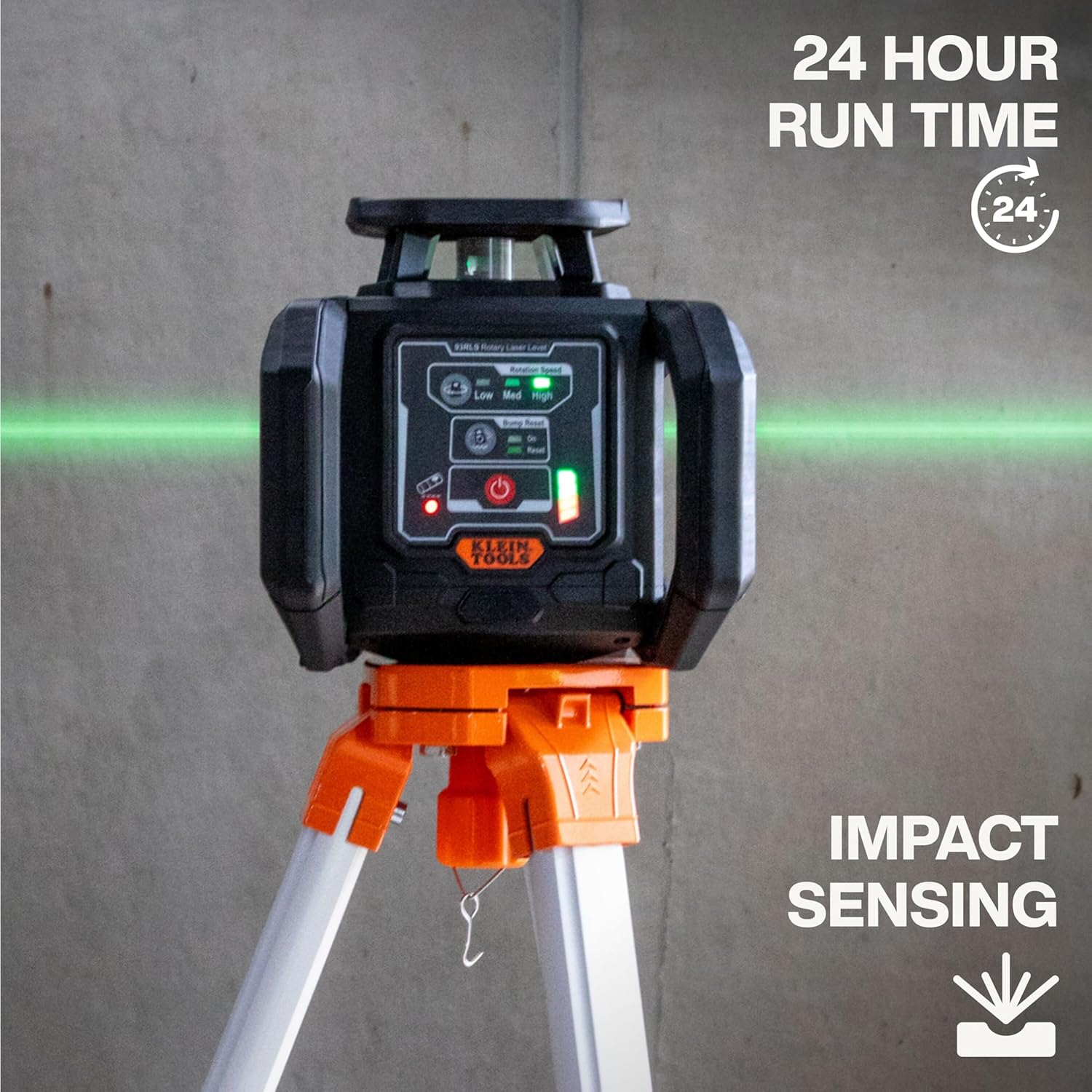
By day four, I had used the laser for setting concrete form stakes across a 40-foot span and for checking the slope of a drainage trench. The consistency was good — the beam did not drift noticeably when left running for several hours. I deliberately bumped the tripod twice to test the impact sensing feature. Both times, the head paused, re-leveled within about 10 seconds, and resumed. That feature works exactly as described. The detector’s audio tone is loud enough to hear over a running generator from about 20 feet away, which is useful when working alone.
The hardest test came on a day with gusty winds around 25 miles per hour. The tripod, which is adequate on calm days, became a liability. The legs are not as thick as a heavy-duty survey tripod, and the center brace does not lock as securely. In gusts, the laser head vibrated enough that the beam on the detector flickered between the upper and lower indicators at 200 feet. I resolved this by hanging a sandbag from the tripod center hook — a field fix, not a solution that should be necessary. This test revealed that the included tripod is adequate for indoor work or calm outdoor conditions, but it is the weakest part of an otherwise solid kit.
By the end of five weeks, I had used the laser for grading the workshop floor, aligning ceiling joists, and checking the level of a retaining wall. The battery never died on me during a work session — I charged it every third or fourth use and never saw the low-battery indicator during operation. The detector mount, which uses a spring-loaded clamp, held securely on the grade rod without slipping. The only wear I noticed was some scuffing on the tripod feet. Nothing broke, nothing loosened, nothing stopped working. This Klein Tools 93RLS review honest opinion is that the unit itself is built for the long haul. The tripod is the one component that should be replaced if you work in demanding conditions regularly.
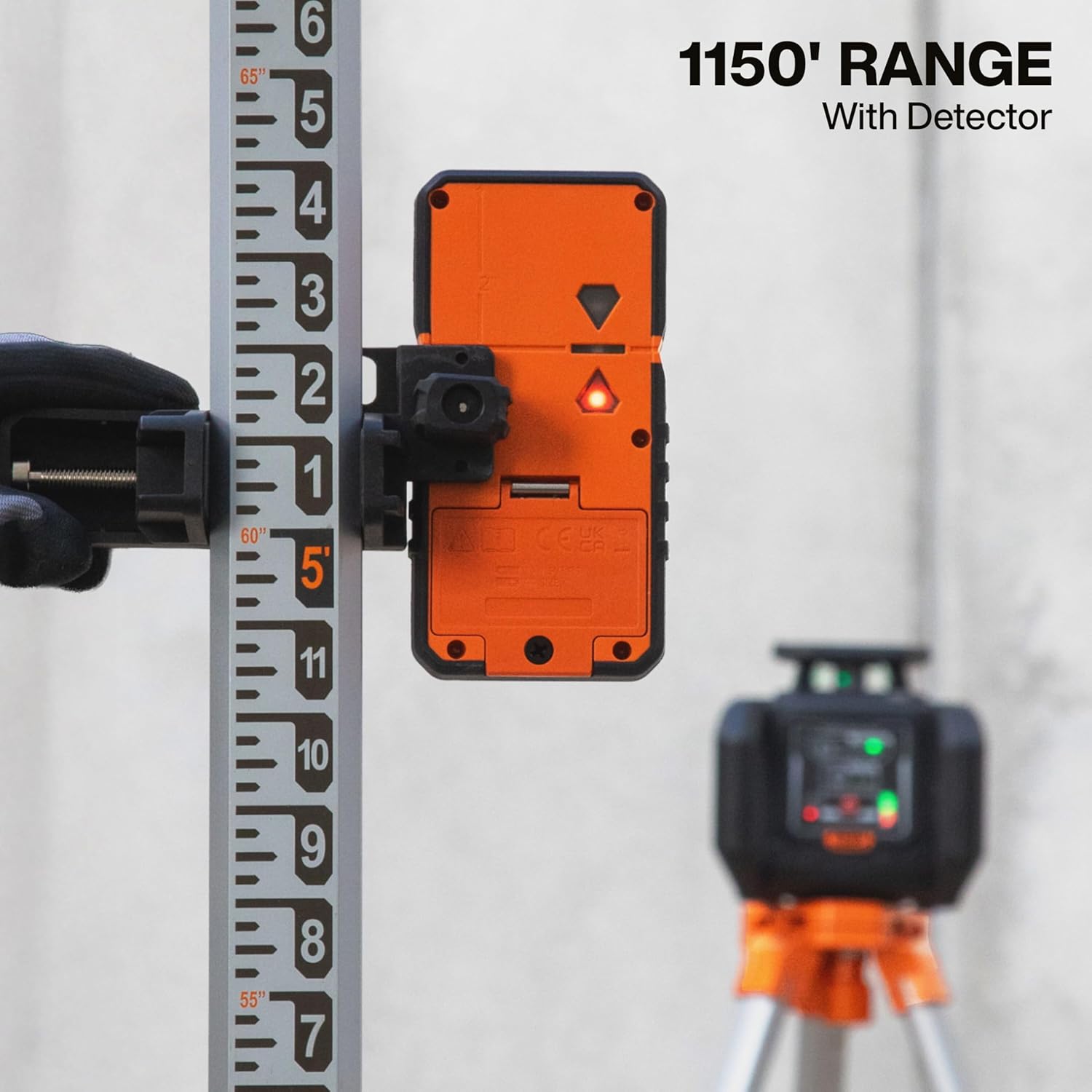
| Specification | Value |
|---|---|
| Brand | Klein Tools |
| Model | 93RLS |
| Laser Type | Class 3R, Green, ≤5mW |
| Range (with detector) | 1150 feet |
| Battery Life | 24 hours (rechargeable) |
| Ingress Protection | IP66 |
| Self-Leveling Range | ±5 degrees |
| Mounting Thread | 5/8-inch survey |
| Weight | 4.36 pounds |
| Material | Metal housing |
| Included Accessories | Detector, mount, 9-ft grade rod, tripod, charger, hard case |
The trade-offs tell a clear story: this kit is optimized for someone who needs a tough, reliable rotary laser with excellent range for horizontal layout. The compromises are in the accessories, not in the laser head itself. The tripod and rod are functional but entry-level. If you already own a good tripod and grade rod, you might be better served buying the laser head alone — assuming Klein offers it that way. If you are starting from scratch and need a complete kit, the 93RLS kit gives you a great core with passable add-ons that you can upgrade over time.
| Product | Price | Key Strength | Key Weakness | Best For |
|---|---|---|---|---|
| Klein Tools 93RLS | $700 | Green diode brightness, IP66 durability, full kit included | No slope capability, tripod is entry-level | Outdoor horizontal layout, foundation and framing work |
| DeWalt DW079LG | $850 | Dual-slope capability, robust tripod included | Higher price, heavier kit weight | Grading and drainage work requiring slope adjustment |
| Bosch GRL4000-80CK | $650 | Red laser with excellent detector range, proven reliability | Red diode is less visible, slightly older design | Indoor or shade work where visibility is less critical |
The Klein 93RLS makes sense when your priority is bright, long-range horizontal layout in outdoor conditions. The green diode and IP66 rating give it an edge over red-laser competitors when working in full sun or wet weather. If your typical job involves setting foundation forms, aligning posts, or checking wall heights across a large footprint, this kit delivers the range and durability you need without the cost of slope features you will not use. The detector performance at distance was genuinely impressive during testing, and the battery life removes a source of daily friction.
If you regularly need to establish a 2 percent slope for driveways, patios, or drainage, the DeWalt DW079LG deserves a hard look. Its dual-slope capability is not a workaround — it is a fundamental feature that saves hours of shimming and guesswork. You will pay roughly 150 dollars more, but the included tripod is also noticeably sturdier. For anyone doing site prep or concrete work as a primary business, the extra cost pays for itself in reduced setup time. For a thorough comparison, check out our tool comparison articles for more category insights.
Charge the laser head fully before first use. The manual says a two-hour charge, and that is accurate. Mount the laser on the tripod hand-tight only — overtightening the 5/8-inch thread can make it difficult to level. Use the bubble vial on the mount plate to rough-level within about 5 degrees before powering on. This cuts the self-leveling time in half. The detector mounts on the grade rod with a spring clamp that slides up and down. Make sure the clamp is tight enough that it does not slide on its own but loose enough that you can move it with one hand. The sweet spot takes about two adjustments to find.
The Klein Tools 93RLS kit is priced at 699.98USD at the time of this review. That positions it in the middle of the full-kit rotary laser market — more expensive than entry-level red lasers with basic accessories, but significantly less than premium dual-slope units that push past 1,200 dollars. The value equation depends entirely on whether you need the accessories. The laser head alone is the star of this kit. If you evaluate the kit as a package, you are paying roughly 450 dollars for the laser head and 250 dollars for the tripod, detector, grade rod, and case. The detector and case are good quality. The tripod and rod are functional but entry-level.
That means the kit offers fair value if you are starting from scratch and need a complete setup. It offers less value if you already own a good tripod and detector — in that case, you would be better served by a bare laser head, assuming Klein or a distributor offers that option. The warranty, according to the documentation, covers defects in materials and workmanship but the standard phrasing is “call vendor for warranty,” which is less transparent than Klein’s typical lifetime warranty on hand tools. I recommend verifying warranty terms with the seller before purchase.
Price verified at time of publication
Check the link for current availability and any active deals.
The Klein Tools 93RLS comes with a limited warranty that covers manufacturing defects. The exact duration is not printed in the included documentation — the manual directs you to contact Klein Tools customer service for warranty details. That is a minor frustration. Based on research, Klein Tools typically offers a one-year warranty on electronic tools, which is standard but not impressive compared to brands that offer three years on lasers. The warranty specifically excludes damage from abuse, unauthorized repairs, and normal wear. Customer support is reachable by phone and email, and Klein’s reputation among tradespeople suggests they stand behind their products. That said, the lack of a clear warranty card in the box is a small but unnecessary friction point for a 700-dollar purchase.
Five weeks of use across foundation layout, concrete forming, framing, and ceiling alignment showed that the Klein Tools 93RLS laser head is built for demanding conditions and delivers reliable range with the detector. The battery lasted through multiple workdays without issue, and the IP66 rating proved to be functional protection, not a marketing line. The weak link in this Klein Tools 93RLS review verdict is the tripod, which is adequate for indoor use but borderline outdoors in wind.
This kit is worth buying for anyone who needs a complete rotary laser setup for outdoor horizontal layout work. The laser head itself earns a 4 out of 5 — docked one point for the lack of slope capability and the entry-level tripod. If you already own a solid tripod and detector, skip the kit and look for the bare laser head if you can find it. If you are buying your first rotary laser and the price fits your budget, this kit will serve you well through years of jobsite use.
If you own the Klein Tools 93RLS and have put it through its paces on your own projects, we want to hear about it. Did the tripod hold up for you, or did you upgrade it? How does the green diode compare to other lasers you have used? Drop your experience in the comments below — your insights help other buyers make a more informed decision. And if you are ready to buy, check the current price here.
Yes, for the right buyer. If you need a full kit with a green rotary laser that can reach 1150 feet with the detector and survive dust and rain, the 93RLS delivers on its promises. The laser head is built to a high standard, the battery lasts as advertised, and the detector is responsive and intuitive. The tripod and grade rod are functional but not premium — factor in 150 dollars for upgrades if you work in demanding conditions. For indoor or calm outdoor use, the kit is complete and ready to go out of the box.
The DeWalt DW079LG costs about 150 dollars more and offers dual-slope capability, which the Klein lacks. The DeWalt also includes a sturdier tripod. The Klein wins on green diode brightness and IP66 protection. If you need slope adjustment, the DeWalt is worth the premium. If you only need horizontal and vertical layout, the Klein offers better value and comparable build quality. The detector performance on both units is excellent, but the Klein’s audio feedback is slightly louder and clearer in my testing.
Setup takes about 15 minutes for a first-time user. The quick-start guide covers the essential steps: charge, mount, level, power on. The most confusing part is the detector operation — specifically understanding that the tone changes pitch as you approach the level plane. Plan to spend about 30 minutes practicing with the detector at different distances before relying on it for critical layout. The learning curve is shallow, but it is not zero. Anyone who has used a standard bubble level or cross-line laser will pick it up quickly.
You will need a USB wall adapter for charging, as the box includes only the USB-C cable. A sandbag for the tripod center hook is highly recommended for outdoor work — it costs about 20 dollars and dramatically improves stability in wind. If you plan to use it on soft ground, tripod spreader feet are a worthwhile addition. For precision work, a sturdier grade rod with a sliding sensor mount will improve repeatability. None of these are required for basic use, but each addresses a specific limitation of the included accessories.
The warranty covers manufacturing defects but the documentation does not specify a duration — it directs you to call Klein Tools for details. Based on brand policies for similar products, expect one year of coverage. The warranty excludes damage from abuse, unauthorized modification, and normal wear. Klein Tools customer support is generally rated well by tradespeople, though wait times can be long during peak seasons. I recommend registering the product online immediately after purchase to establish a record of ownership.
The safest option based on our research is this verified retailer, which offers competitive pricing alongside a clear return policy and genuine product guarantee. Avoid third-party marketplace sellers offering prices significantly below retail — counterfeit lasers are rare in this category but they do appear on secondary markets. Buying from an authorized Klein distributor ensures you receive the full warranty and genuine accessories.
In direct sunlight, the green beam is visible to the naked eye at roughly double the distance of a red laser at the same power level. At 80 feet in full sun, the green line is faint but usable. A red laser becomes unusable around 40 feet in the same conditions. With the detector, both colors work at their full rated range — the detector does not care about color. The real advantage of green is speed: you can often read the beam without the detector in conditions where a red laser would require it. That saves setup time on every job.
Yes, but with one caveat. The impact sensing paused the beam every time I deliberately bumped the tripod, and the re-leveling was accurate each time. The indicator icon on the laser head clearly shows whether the unit has been disturbed. I still recommend double-checking your reference point after any significant bump, simply because the cost of being wrong on a foundation layout is high. For less critical work like checking ceiling height, I trusted the indicator alone after the first week of testing.
Reviews You Can Actually Use
We test products so you do not have to guess. No sponsored rankings. No filler content. Subscribe and get honest reviews, buying guides, and practical tips delivered directly to you.