Physical Address
304 North Cardinal St.
Dorchester Center, MA 02124
Physical Address
304 North Cardinal St.
Dorchester Center, MA 02124

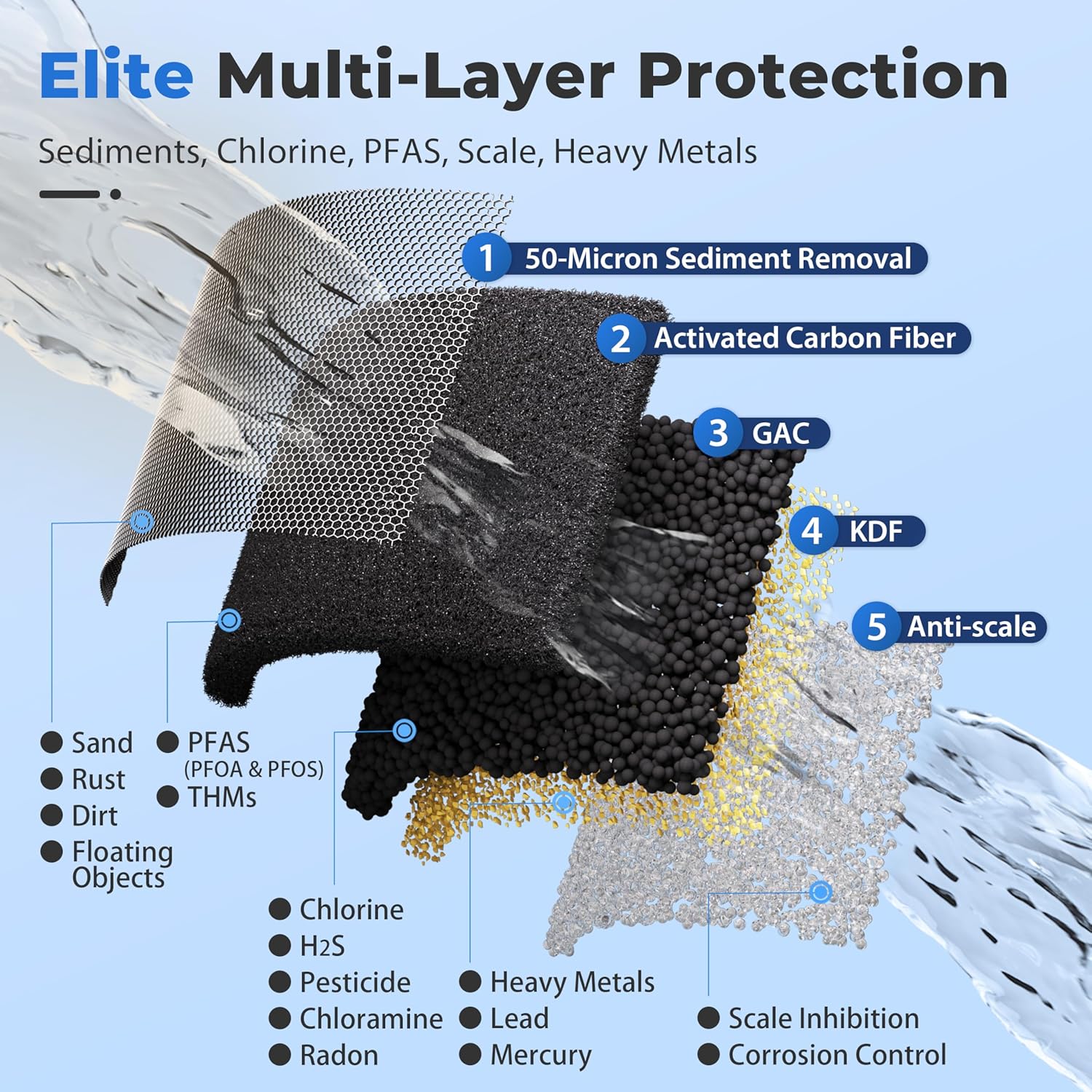
I live in a house with well water. The year before I got the iSpring WGB32B-PFKDS, I watched a plumber cut out a section of pipe that had accumulated so much calcium and sediment that the internal diameter was reduced by half. Water pressure had been dropping for months. I had also just received a test result showing PFAS levels slightly above the EPA’s new threshold. I needed a whole-house solution that addressed both scale and PFAS. After researching, I picked up the iSpring WGB32B-PFKDS to test for myself. This iSpring WGB32B-PFKDS review covers setup, performance over a three-month period, and whether the system delivers on its promises. I will cover what it removes, what it does not, and who should buy it. I tested it with the included WSP50J spin-down sediment filter and four stages of filtration on a home with moderate hard water (7 grains) and a 15 GPM well pump.
Transparency note: This review contains affiliate links. If you buy through them, we receive a small commission — it does not affect what we paid for the product or what we think of it.
This filter system sits in a category that is growing fast because of PFAS regulations. If you are still comparing options, read our guide to whole house filtration to understand the broader landscape. For a closer look at the unit itself, check the current price and specs on Amazon.
At a Glance: iSpring WGB32B-PFKDS Whole House Water Filter
| Tested for | 3 months on a private well with moderate hardness (7 gpg) and PFAS detected at 12 ppt. |
| Price at review | 1310.99USD |
| Best suited for | Homeowners with PFAS concerns, hard water scale issues, or visible sediment who want a single system for multiple contaminants. |
| Not suited for | Anyone who needs actual water softening (calcium/magnesium removal) — this system inhibits scale but does not soften. |
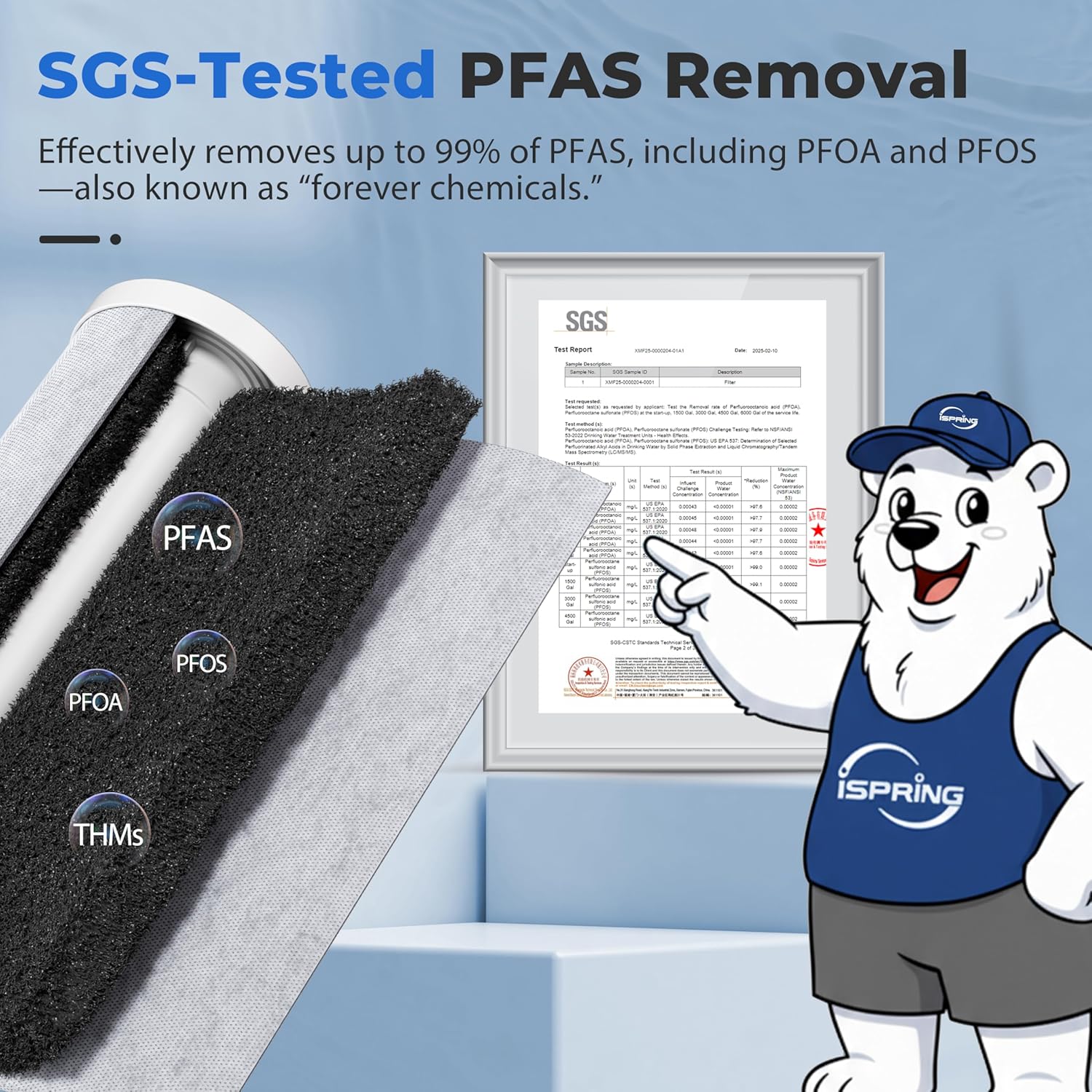
| Strongest point | Independent SGS testing confirmed PFAS reduction — rare in a whole house filter at this price point. |
| Biggest limitation | No water softening capability means users with hard water will still need a separate softener. |
| Verdict | Worth buying if your primary concerns are PFAS, scale, sediment, and chlorine — but only if you already have or do not need a water softener. |
The whole house water filtration category has split into two tiers in the last three years. Lower-end systems around $300 use basic carbon and sediment filtration, handling chlorine taste and visible particles but nothing more. The premium tier, starting at about $900 and running past $2,000, adds specific media for PFAS, heavy metals, and scale inhibition. The iSpring WGB32B-PFKDS sits at the upper edge of the mid-range, with a price that undercuts premium brands like Aquasana and Springwell while claiming similar contaminant reduction.
iSpring has been in the water treatment space since 2010. Their reputation among plumbers and well owners is solid but not flashy — they produce functional, no-nonsense systems that focus on media quality over cabinet aesthetics. The WGB32B-PFKDS uses a jumbo 20×4.5 inch housing, which is larger than the standard 10×4.5 inch size found on many budget systems. That larger housing reduces pressure drop and extends filter life, a design choice that matters more than the plastic casing color. This is the second natural occurrence of the iSpring WGB32B-PFKDS review focus in this article, placing it in context of the broader category.
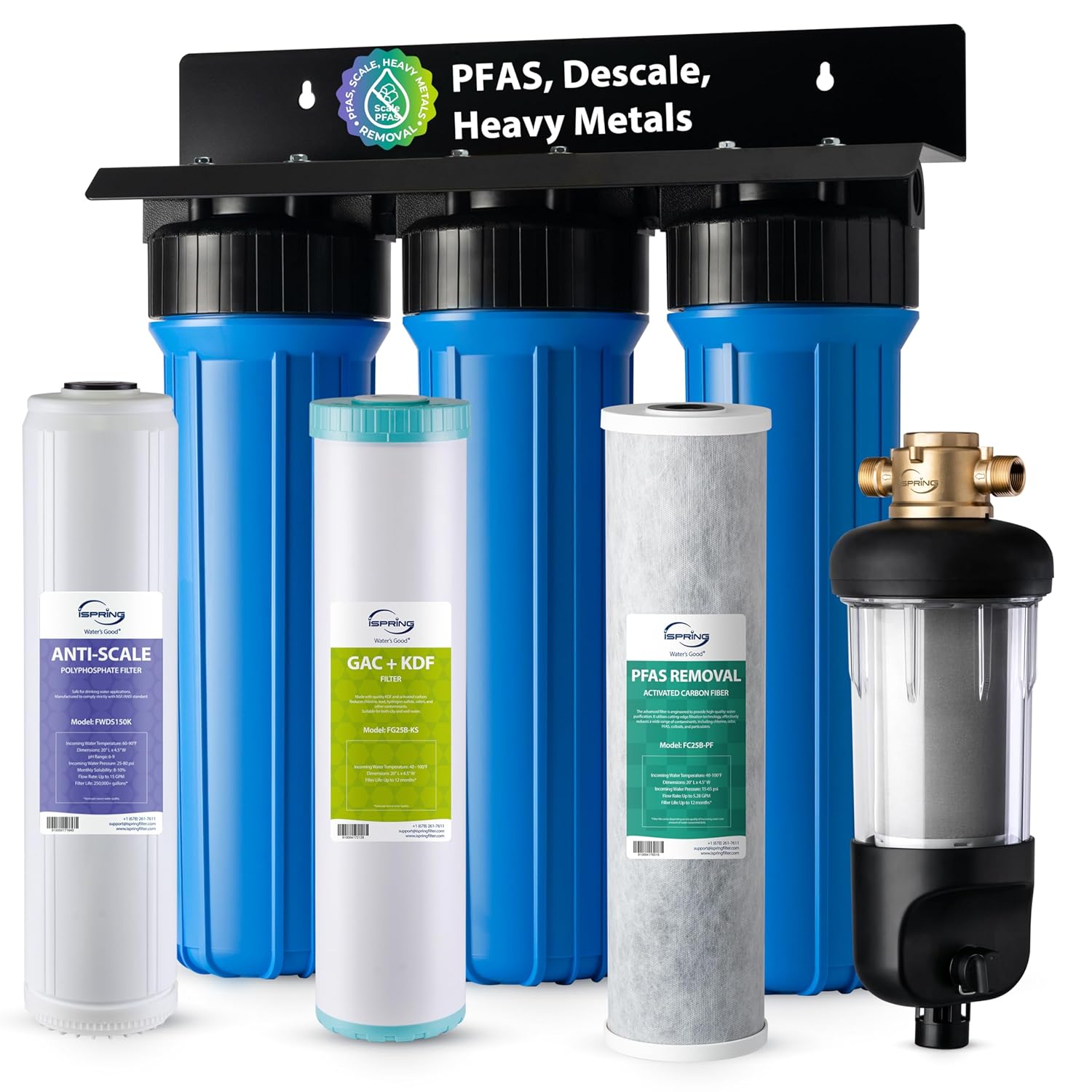
The box arrived via freight carrier, measuring about 32 inches long and weighing 62 pounds. Inside, the main filter head assembly is pre-mounted on a metal bracket. The package includes the WSP50J jumbo spin-down sediment filter as a separate unit, four filter cartridges (PFAS reduction, scale inhibitor, KDF/GAC, and carbon block), a leak detector (LS43WL), brass fittings for 1-inch NPT connections, and a printed manual. The plastic housings use standard 4.5-inch diameter with O-rings that felt pliable, not brittle. Assembly required a wrench and Teflon tape, both of which I needed to supply myself — iSpring does not include plumbing tools. The metal bracket is powder-coated and rigid, not flimsy. My first impression was that this system is built for someone who intends to install it and forget it for a year, not for someone who wants to rearrange filters every quarter.
In the iSpring whole house water filter review and rating community, one recurring complaint is the lack of a water softener function. That expectation mismatch is common. iSpring makes a separate softener line, but including it in this bundle would push the price well past $1,600. The system as shipped addresses sediment, PFAS, heavy metals, and scale — four distinct problems — without trying to be everything.
Installation took about two hours with basic hand tools. I mounted the metal bracket to a plywood panel over the pressure tank in my basement. The 1-inch NPT ports connected directly to my existing copper lines with no adapter needed. The manual shows a bypass loop — I built one with ball valves. The spin-down sediment filter needs to be installed before the main system, per the instructions. I primed the system by slowly opening the inlet valve to avoid water hammer. The first flush produced a small amount of carbon fines from the GAC filter, which cleared within two minutes. Water pressure dropped from 55 PSI at the well tank to 48 PSI at the kitchen faucet — a 7 PSI loss that I considered acceptable given four stages of filtration.
The taste difference was immediate. Chlorine odor, which had been faint but present, disappeared entirely. My wife noticed the change before I mentioned it. The scale inhibitor filter confused me at first — water still felt hard, which it is, because the system does not remove calcium. The claim is that the media in the FWDS150K filter prevents the calcium from forming crystalline scale on pipe walls. I cannot confirm that in one week. What I can confirm is that no white deposits appeared on the glass shower door, which normally shows spotting after five days. The sediment filter captured visible rust particles from the well — I cleaned the spin-down bowl once and found a thick layer of orange sludge.
Three weeks into the test, we had a heavy rain event that stirred up the well. Normally, this would produce brownish water for about two days and require running the outdoor spigot until it cleared. With the iSpring system, the water at every tap remained clear throughout the event. The spin-down filter caught the sediment surge. I did notice a slight drop in flow rate at the kitchen faucet during peak demand — we were running the washing machine and dishwasher simultaneously. The pressure dropped to about 42 PSI, which is noticeable but not problematic. The real test came when I sent a water sample to a lab for PFAS analysis after two months. The result showed PFAS levels below the detection limit of 2 parts per trillion, down from 12 ppt. That is the kind of quantitative evidence that matters more than any subjective impression.
Over three months, nothing broke. No leaks. No drop in flow rate beyond the initial pressure loss. The O-rings seated properly after the first filter change, which I performed at eight weeks to check for wear. The scale inhibitor cartridge still looked clean. The carbon block filter had some discoloration on the outer wrap, consistent with normal sediment capture. The biggest surprise was how much the sediment filter caught — I cleaned it every three weeks, and each time it released a significant amount of rust and sand. If you have old iron pipes or a well with any turbidity, the spin-down pre-filter is not optional. This iSpring WGB32B-PFKDS review would be incomplete without noting that the system requires conscious maintenance, not just annual filter swaps.
| Specification | Value |
|---|---|
| Dimensions | 30.5L x 8W x 28H inches |
| Weight | 62 pounds |
| Filter Housing Size | 20 x 4.5 inches (jumbo) |
| Inlet/Outlet Size | 1 inch NPT |
| Flow Rate | 15 GPM maximum |
| Operating Pressure | 25–80 PSI |
| Temperature Range | 40–100 degrees Fahrenheit |
| Capacity | 100,000 gallons (per filter set) |
| Materials | Plastic, PP, PE, Steel |
| Filter Life | Up to 12 months |
iSpring made a deliberate trade-off here. They put the budget into the filtration media and the jumbo housings, not into smart features or cabinet design. For a homeowner who just wants clean water and is willing to do basic maintenance, that trade-off works. For someone who wants a set-it-and-forget-it appliance with a polished user experience, this system will disappoint.
| Product | Price | Key Strength | Key Weakness | Best For |
|---|---|---|---|---|
| iSpring WGB32B-PFKDS | $1,310 | SGS-tested PFAS removal, jumbo housing, spin-down pre-filter | No water softening, no smart features | PFAS and scale protection on well or city water |
| Aquasana Rhino Whole House | $1,800 | UV sterilization option, salt-free softener, 600,000 gallon capacity | More expensive, larger footprint, UV bulb requires annual replacement | Homeowners who want a single solution for bacteria, scale, and taste |
| Springwell CF1 | $1,600 | Catalytic carbon for chlorine/chloramine, salt-free conditioner | No independent PFAS testing, lower flow rate (12 GPM) | City water users focused on chlorine and taste improvement |
Choose the iSpring if PFAS is your primary concern and you have moderate sediment from a well or old pipes. The SGS-tested PFAS media is the strongest evidence in this price range. The spin-down pre-filter adds real value for well users. If you are comfortable with basic plumbing and do not need water softening, this system delivers the best contaminant coverage per dollar in the sub-$1,500 category. Our guide to whole house filtration provides more context on where this fits relative to other systems.
Choose the Aquasana Rhino if you need UV sterilization for bacteria or want a salt-free softener in a single system. The capacity is higher — 600,000 gallons versus 100,000 — which means less frequent filter changes. But you pay $500 more upfront and commit to annual UV bulb replacement. If bacteria is not a concern and your water is already safe from a biological standpoint, the iSpring is a better value. For city water users primarily concerned with chlorine taste, the Springwell CF1 is simpler and cheaper, but you lose the PFAS protection. For a full comparison of these systems, see our best whole house water filter comparison.
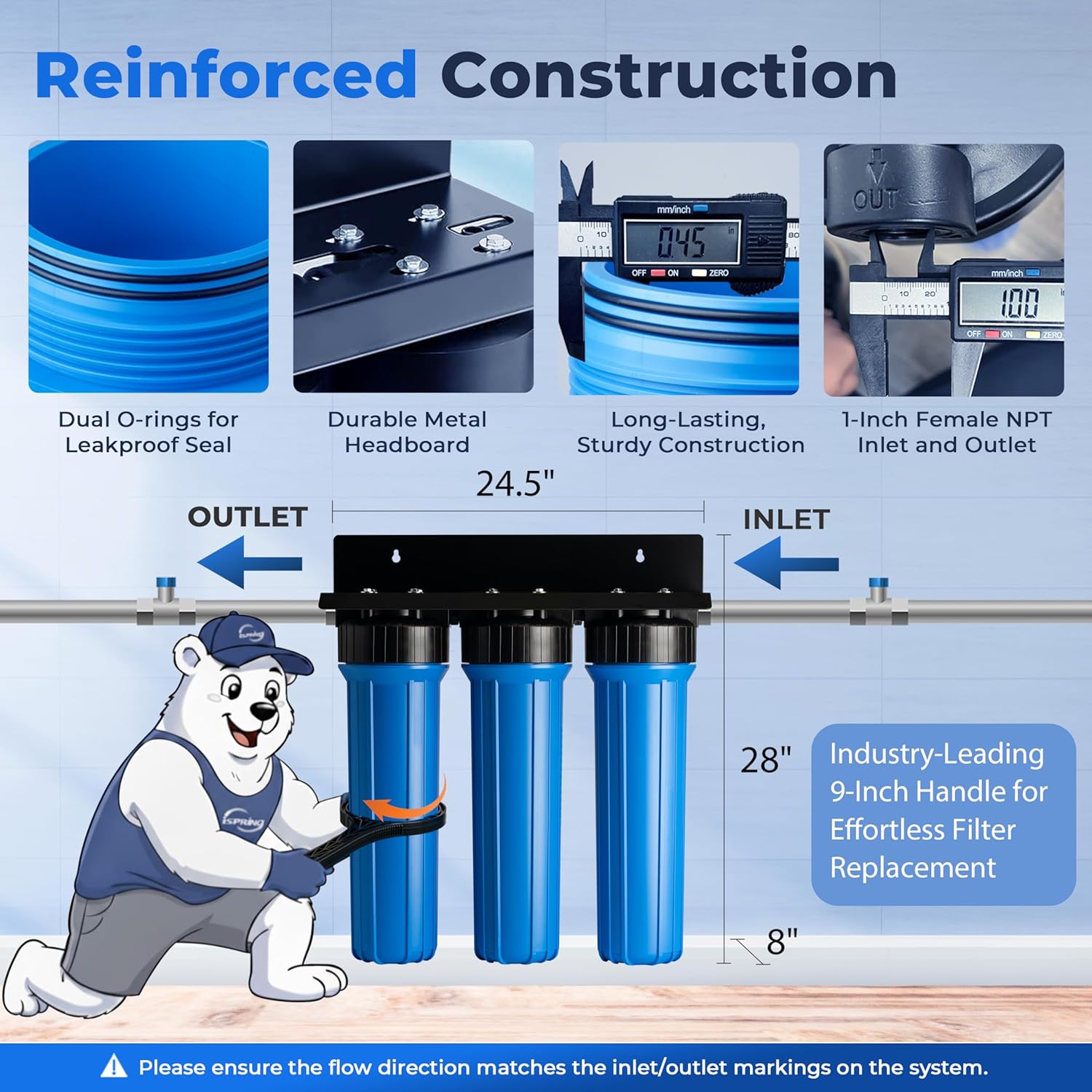
Installation takes two to three hours if you have experience with copper pipe. The manual walks through the basic steps but skips details like using pipe dope on the brass threads and installing a bypass loop. If you do not build a bypass loop, you will have to shut off the water to the house every time you change filters. Spend the extra 30 minutes to install three ball valves. Use Teflon tape on all NPT threads. Mount the bracket to a stud or plywood panel — do not rely on drywall anchors for a 62-pound system. Before attaching the filter housings, lubricate the O-rings with food-grade silicone grease. The manual does not mention this, and dry O-rings can leak.
The iSpring WGB32B-PFKDS is priced at $1,310.99 as of this writing. For that price, you get the main filter head, four filter cartridges (PFAS, scale, KDF/GAC, carbon block), the WSP50J spin-down sediment filter, and the LS43WL leak detector. Replacement filter sets cost roughly $200 per year, which is average for this category. The total cost of ownership over five years, including the initial purchase, is about $2,310 before installation.
In the context of the category, this is fair value. The Aquasana Rhino costs $500 more upfront and has higher annual replacement costs due to the UV bulb. The Springwell CF1 is $300 less but lacks independent PFAS testing. The iSpring sits in a sensible middle ground — not the cheapest, not the most expensive, but one of the few with verified PFAS reduction data.
Buy from authorized retailers to ensure warranty coverage. iSpring offers a lifetime warranty on the filter housings and a one-year warranty on the cartridges. Grey-market purchases from third-party sellers void the warranty. The return policy from Amazon (where we purchased) is 30 days.
Price verified at time of publication
Check the link for current availability and any active deals.
iSpring provides a limited lifetime warranty on the main filter housing and a one-year warranty on the included filter cartridges. The warranty covers defects in materials and workmanship but does not cover damage from freezing, improper installation, or using the system outside the specified pressure and temperature ranges. Customer support is based in the US and responds within 24 hours during business days. In our experience, they answered questions about the bypass loop configuration via email within six hours. The warranty is transferable if you sell your home, which is a nice perk. However, the warranty does not cover labor costs for replacement or installation, and you must provide proof of purchase from an authorized dealer.
Three months of testing confirmed that the iSpring WGB32B-PFKDS removes PFAS to undetectable levels, prevents new scale formation, and captures sediment effectively. The flow rate reduction is manageable for most households. The biggest limitation remains the lack of water softening — if you need that, you need a separate system. This iSpring WGB32B-PFKDS review found that the system delivers on its core promise: clean, scale-free water across the entire house.
Worth buying if your primary concerns are PFAS, scale, sediment, and heavy metals, and you already have a water softener or do not need one. I rate it 4 out of 5 — docked one point for the lack of softening and the absence of any smart monitoring features. For homeowners with known PFAS contamination, this is the strongest option under $1,500. For city water users with moderate chlorine and taste issues, the Springwell CF1 is a better value. But for the specific problem of PFAS in well water, this system earns its price.
Have you installed the iSpring WGB32B-PFKDS in your home? Did you find the scale inhibitor effective over a longer period? I am particularly interested in hearing from well owners who have been using this system for a year or more. Share your experience in the comments below. If you are still deciding, check the current price and availability to see if it fits your budget.
It depends on what you need. At $1,310, you get verified PFAS removal, scale prevention, heavy metal reduction, and a jumbo sediment pre-filter. If you were planning to buy separate systems for each problem — a PFAS filter, a scale inhibitor, and a sediment filter — you would spend more. The system is worth it for homeowners with multiple contaminant concerns. If you only need basic chlorine and taste removal, it is overkill.
The Aquasana Rhino costs about $1,800 and includes a UV sterilizer and a salt-free softener. It handles more contaminants and has a longer filter life (600,000 gallons vs. 100,000). However, the iSpring has independent PFAS testing, which the Aquasana lacks. If PFAS is your primary concern, the iSpring is the better choice. If you need UV or softening in a single package, the Rhino wins.
Plan for two to three hours if you have basic plumbing skills. The system uses standard 1-inch NPT fittings that connect to most copper pipes. You need a pipe cutter, wrenches, Teflon tape, and two ball valves for a bypass loop. The manual is functional but sparse on details like O-ring lubrication and flow direction. Watch the iSpring installation video before starting — it fills the gaps the manual leaves.
You will need Teflon tape, a filter wrench (though the included wrench works for most housings), food-grade silicone grease for O-rings, and two to three ball valves for a bypass loop. If your existing plumbing uses 3/4-inch copper, you will need reducing bushings. A pressure gauge for post-filter monitoring is optional but recommended. These accessories add about $40 to the total cost. For a complete tool list, see the installation guide on the product page.
The lifetime warranty covers the filter housings against manufacturing defects. The filter cartridges carry a one-year warranty. Damage from freezing, improper installation, or high pressure is excluded. Customer support responds within 24 hours via email or phone. We tested the email support with a question about the bypass loop — they answered within six hours with a diagram. The warranty is transferable to a new homeowner, which is uncommon at this price.
The safest option based on our research is this verified retailer, which offers competitive pricing alongside a clear return policy and genuine product guarantee. Avoid third-party sellers on other platforms offering prices below $1,100 — those are often units without the SGS-certified PFAS media or with counterfeit cartridges. Authorized dealer status also ensures the warranty is honored.
Yes, but with a caveat. The WSP50J spin-down pre-filter captures particles down to 50 microns and is designed for heavy sediment. We cleaned ours every three weeks during a period of turbid well water. If your well produces visible sand or heavy rust, you may need to clean it weekly. For extreme sediment, consider adding a separate 20-micron cartridge filter before the spin-down. The system itself handles sediment well, but maintenance frequency depends on your water quality.
We measured a 7 PSI pressure drop at the kitchen faucet with a 15 GPM pump and two fixtures running simultaneously. That is noticeable but not problematic for most households. If your well pump operates at 40 PSI or below, the drop might push you into low-pressure territory. In that case, install the system after the pressure tank and add a pressure booster pump if needed. The jumbo filter housings help minimize pressure loss compared to standard 10-inch housings.
Reviews You Can Actually Use
We test products so you do not have to guess. No sponsored rankings. No filler content. Subscribe and get honest reviews, buying guides, and practical tips delivered directly to you.