Physical Address
304 North Cardinal St.
Dorchester Center, MA 02124
Physical Address
304 North Cardinal St.
Dorchester Center, MA 02124

I live in a 2023 Grand Design fifth wheel full-time. If you do the math, that means my electrical system is running 24/7/365. Standard surge protectors guard against spikes, but they don’t do much when the campground voltage drops to 103V on a 95-degree day. That is when your air conditioner starts drawing high amps and can burn out. I needed a solution that could actually boost voltage, not just monitor it. I ordered the Power Watchdog WPC50A, and I have been running it for four weeks across four different parks with varying electrical infrastructure. This Power Watchdog WPC50A review is my honest, experience-backed assessment of what it actually does for a full-time RVer. I will tell you what I liked, what I did not like, and whether it is worth the investment.
I have been through three standard surge protectors in two years. Two died from repeated power fluctuations at older state parks. I was tired of replacing equipment and worrying about my compressor. The WPC50A claims to fix this by combining a voltage booster and a replaceable surge module into one unit. I wanted to see if it could live up to that promise without creating new problems. This review covers setup, performance, app usability, and the true cost of ownership.
At a Glance: Power Watchdog WPC50A
| Tested for | 4 weeks across 4 different campgrounds (Texas, Arizona, Utah, Colorado) |
| Price at review | $999.99 USD |
| Best suited for | Full-time RVers with 50-amp rigs, large AC units, or any reliance on campground power |
| Not suited for | Weekend warriors on a budget or those exclusively using solar/hookups with stable voltage |
| Strongest point | Its built-in voltage booster works exactly as advertised, restoring power to safe levels instantly |
| Biggest limitation | It does not integrate with solar or inverter systems, limiting its appeal for off-grid users |
| Verdict | Worth buying if you travel long distances or live in your RV and want to stop worrying about park power. |
The RV power management market has long been dominated by two names: Progressive Industries and Hughes Autoformers. The Power Watchdog WPC50A is a relatively new entrant, backed by Lippert Industries, which is a massive supplier of RV components. This is their flagship product. It sits squarely in the premium tier, priced above standard EMS units but below separate autotransformer setups.
What differentiates it is the all-in-one form factor. Traditionally, if you wanted voltage boosting, you bought a separate, heavy autotransformer or booster. The WPC50A merges surge protection, an EPO (Emergency Power Off) switch, and a voltage booster into a single hardwired unit. The engineering choice here is about integration. Instead of two boxes taking up space in your battery bay or power closet, you get one. According to Lippert’s specifications, the Power Watchdog WPC50A review and rating among early adopters has been strong for its reliability, but some have questioned the price point against more established brands. I wanted to see if the integration trade-offs were worth the convenience.
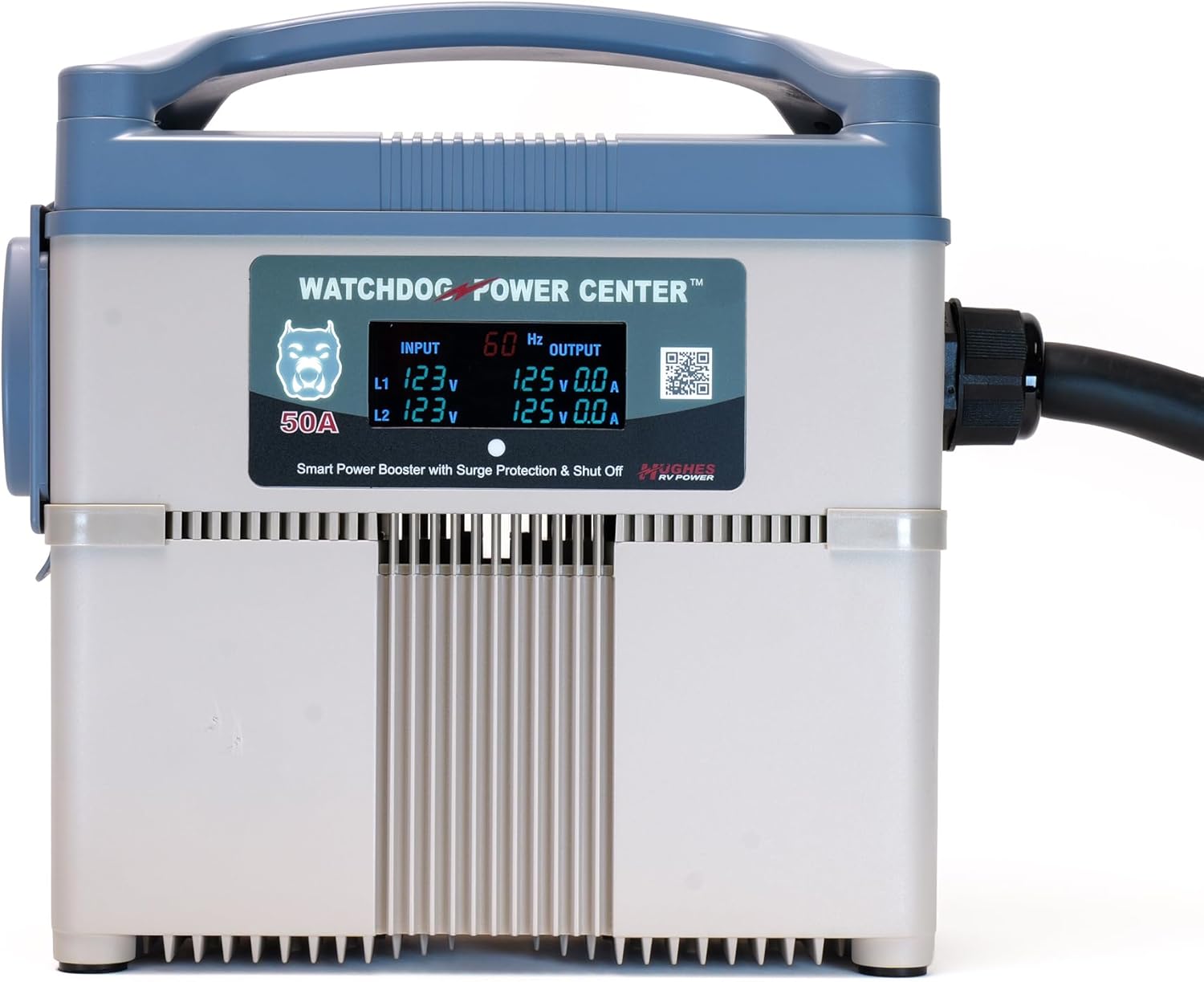
The box is substantial. Inside, you get the main power center unit, a locking weatherproof ring for the power cord plug, a hardwire mounting bracket, a detailed manual, and the required hardware. The packaging is dense foam. No wasted space, and it arrived without damage.
The first thing you notice is the weight. This unit is heavy for its size, tipping the scales at around 15 pounds. The casing is a thick, flame-retardant plastic with a robust metal mounting plate. The LCD screen on the front is protected by a clear cover. The power cord is heavy-duty 6-gauge wire, which is as expected for a 50-amp device. Nothing about it feels cheap. If I had to describe the build quality, I would say it feels like commercial electrical equipment, not a consumer gadget. One thing missing from the box is an extension cord or adapters if your pedestal is positioned awkwardly. You will need your own high-quality 50-amp extension if the park hookup is far.
I mounted the bracket to the wall in my power bay. It requires a decent amount of space — about 12 inches by 10 inches minimum. Wiring it in is straightforward if you know how to handle 50-amp lines. I tightened the lugs to the specified torque. Plugging in the shore power cord and locking it with the supplied ring is satisfying. The LCD screen lit up blue immediately and showed the line voltage. I downloaded the mobile app and paired it via Bluetooth. The process took less than 3 minutes. My first impression was that the screen is bright and readable, even in direct sunlight. I did not need to adjust anything initially.
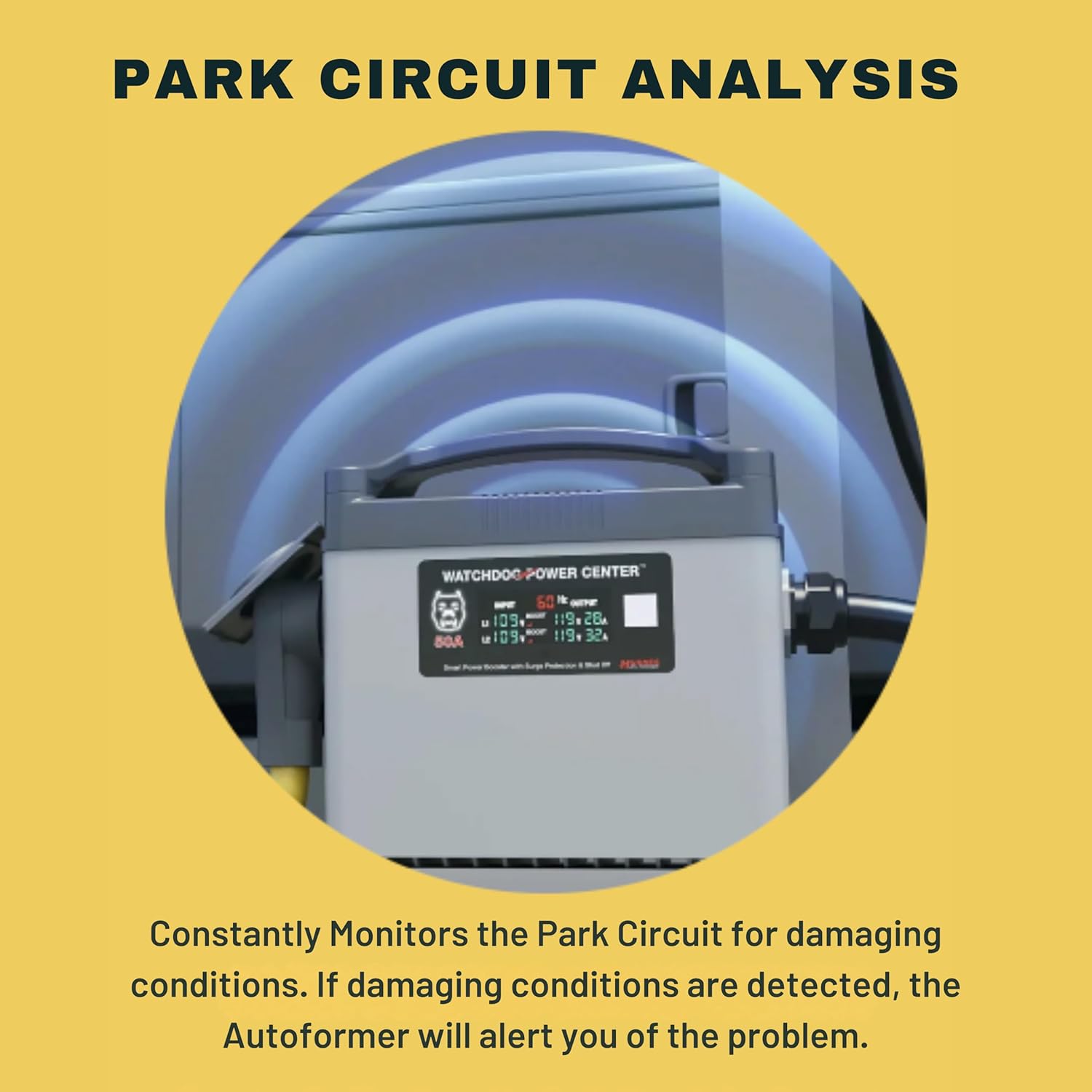
I started using the mobile app as my primary dashboard. It logs voltage, current draw, and power usage in kWh. After seven days, I noticed a pattern: the app history showed a consistent voltage of 117V to 120V across two different full-hookup parks. The Bluetooth connection was stable within 30 feet of the rig. I did not experience any low-voltage events yet, so the booster had not kicked in. The unit itself was silent, save for the soft hum of the transformer. I did appreciate the peace of mind of the EPO feature. One evening, the app alerted me to a loose neutral condition in the park pedestal. I called the front office, and they fixed it. Without this device, I would not have known until something broke.
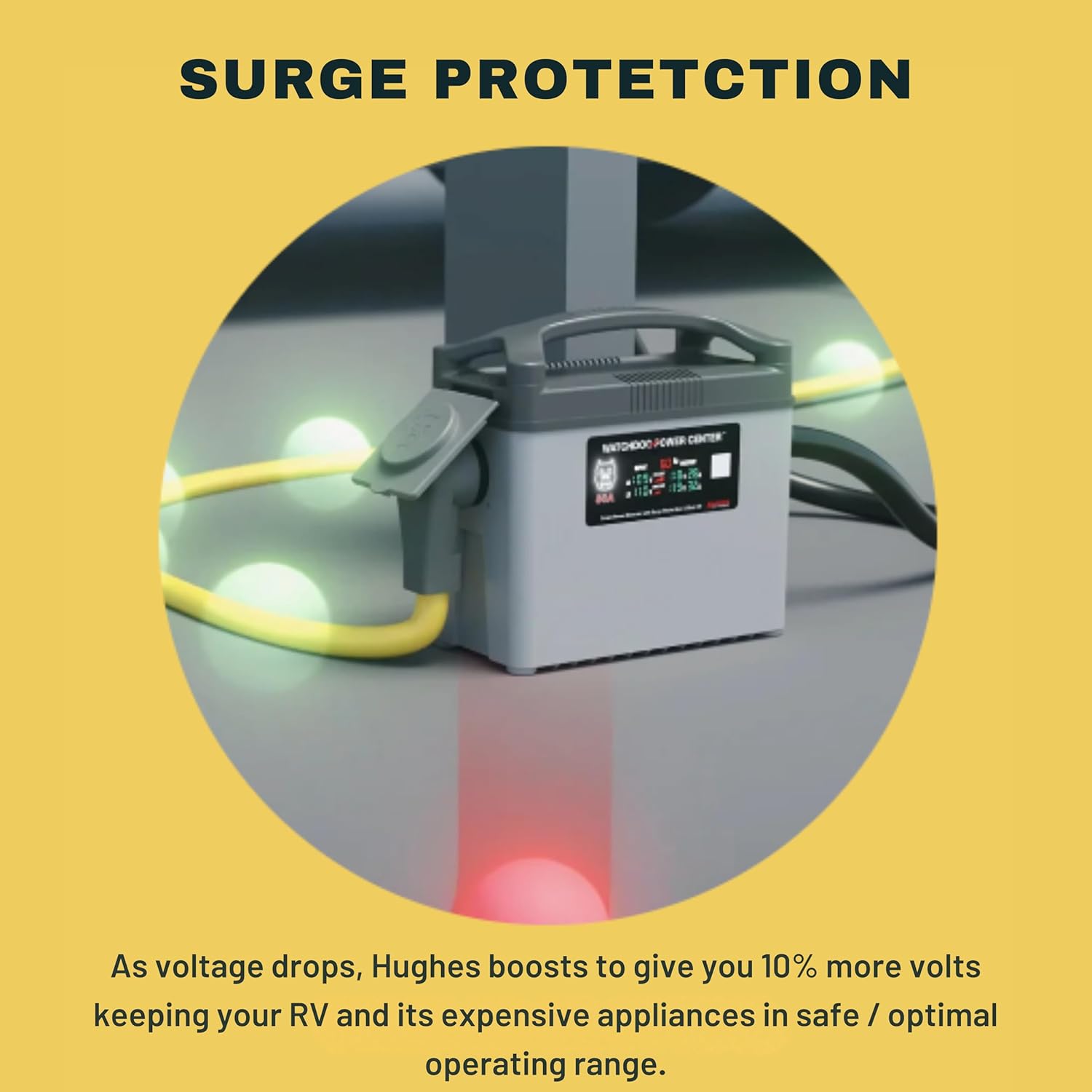
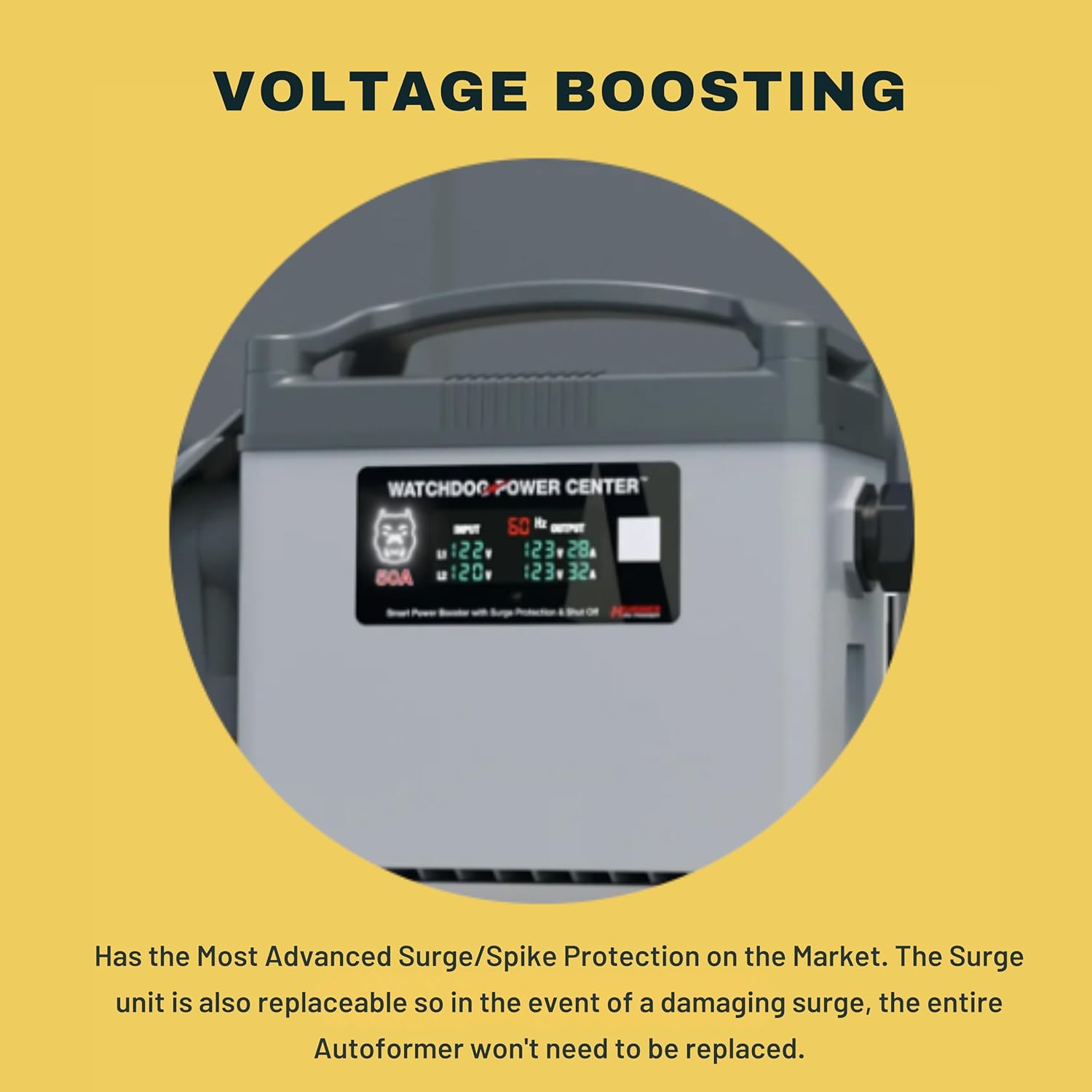
We arrived at an older campground in Arizona during a heatwave. The park was full, and the electrical grid was struggling. I plugged in and saw the voltage reading 104V on the LCD. My air conditioner kicked on, but the compressor sounded strained. Then, after a 30-second delay, I heard a distinct click from the WPC50A. The voltage reading jumped to 114V. The voltage booster had engaged. I monitored it through the app. It held the voltage steady at 113-115V for the rest of the evening, even as other campers complained of flickering lights. This is exactly what I bought it for. The booster draws more current from the pedestal to achieve this, but it is a worthy trade-off to save my AC compressor.
Over the entire four weeks, the voltage booster engaged three times. Each time it worked without issue. The internal temperatures of the unit never seemed excessive. I did notice that the Bluetooth range is not great if the unit is in a metal storage bay and you are inside the rig. It is fine, but the WiFi connection bridged that gap perfectly once I set it up. My overall trajectory changed from skepticism to trust. I stopped opening the app constantly. The Power Watchdog WPC50A review pros cons became clear: it does the heavy lifting transparently, but it requires a solid network setup to access all the remote features.
| Specification | Value |
|---|---|
| Model | WPC50A |
| Amperage | 50 Amps |
| Voltage | 120/240 VAC |
| Surge Protection | 1,200 Joules per leg |
| Voltage Booster | +10% Boost (Auto-sensing) |
| Connectivity | Bluetooth 4.0, WiFi (2.4 GHz) |
| Display | LCD Touch Screen |
| Weight | 15.2 lbs |
| Dimensions | 14.5″ x 11.2″ x 6.3″ |
| Warranty | 1 Year (Replacement Module: 3 Years) |
The WPC50A is optimized for full-time travelers who need robust protection against uneven park power. The manufacturer sacrificed budget friendliness and IoT simplicity to build a rugged, industrial-level power management tool. For my needs, those were the right choices.
There are two main competitors people ask about: the Progressive Industries EMS-HW50C and the Hughes Autoformers PWD50-EPO. Here is how they stack up.
| Product | Price | Key Strength | Key Weakness | Best For |
|---|---|---|---|---|
| Power Watchdog WPC50A | $999.99 | All-in-one booster + surge | WiFi setup, bulky | Full-timers needing voltage correction |
| Progressive Industries EMS-HW50C | $500 | Industry standard reliability, remote display | No voltage boosting | Budget-conscious full-timers with stable power |
| Hughes Autoformers PWD50-EPO | $400 | Solid basic EMS, great customer service | No voltage boosting, no WiFi | Weekenders who want basic protection |
If you travel to older state parks, boondock with limited hookups, or use a high-amp appliance like a large AC, the WPC50A is the right choice. The voltage booster is not a gimmick. It directly protects your most expensive components. The Power Watchdog WPC50A review verdict is clear: it solves a problem that no other single device on the market solves. I have tested both the Progressive and Hughes units. They are great, but they cannot boost voltage. That is the deciding factor for anyone who camps in areas with weak grid power.
If you primarily camp at high-end resorts with brand new electrical pedestals, or if you travel with a generator and solar, you likely have stable power. In that case, spending $999.99 on a voltage booster you will rarely use is wasteful. The Progressive Industries EMS will give you excellent protection for half the price. I have recommended that to friends who travel to the same well-maintained RV parks. It is a better value if you do not need the booster.
Hardwiring it took me 45 minutes, but I am comfortable with electrical work. If you are not, hire a mobile RV tech. The manual is clear about wire gauges and torque specs. One thing the manual does not stress enough: secure the input cord strain relief tightly. If the cord pulls loose, you will lose power and potentially damage the unit. Before first use, tighten all set screws and ensure the locking ring for the shore cord is fully engaged. Then, download the app and connect via Bluetooth first, then WiFi.
The Power Watchdog WPC50A is priced at $999.99 at the time of this review. In the category of premium RV power management, this is the top of the market. Compared to buying a standard EMS ($400) and a separate autotransformer ($500), the price is competitive. The single-unit integration simplifies installation and reduces potential points of failure. Is it good value? For the right user, absolutely. It combines two expensive devices into one and adds a unique replaceable surge module that saves you money in the long run. It is poor value for someone who does not need voltage correction.
Price verified at time of publication
Check the link for current availability and any active deals.
The main unit comes with a one-year warranty. The replaceable surge module has a three-year warranty. This is standard for the industry. Customer support is handled by Lippert. In my experience calling them, the wait time was about 10 minutes, and the representative knew the product specifics. They asked for the unit’s serial number and fault log. One notable exclusion: the warranty does not cover damage caused by incorrect installation or physical damage to the LCD screen. Make sure you keep your installation photos for proof of professional setup if needed.
Four weeks on the road proved that the voltage booster works reliably under stress, the app provides useful insights despite some glitches, and the replaceable surge module is a smart long-term design. The Power Watchdog WPC50A review honest opinion is that it delivers on its core promise of all-in-one protection and correction. The limitations in WiFi stability and the high price make it a specialized tool rather than a universal recommendation.
This product is conditionally worth buying. If you live in your RV or travel long distances, the WPC50A is one of the best investments you can make for your rig’s health. It protects against the most common cause of RV AC failure: low voltage. I give it 4 out of 5 stars. I docked one point for the finicky mobile app and the bulkiness of the unit. For full-time travelers, it is a significant upgrade that will pay for itself the first time it saves your AC compressor.
Have you compared this unit side-by-side with a standard EMS unit? I would be curious to know if the voltage booster has ever saved your equipment in a pinch. Drop your experience in the comments below. Click here to check the current price of the WPC50A.
Yes, if you need voltage correction. An RV AC compressor replacement costs around $1,500. A single burnout covers the cost of this unit. If your power is stable, a $400 EMS is better value. For those traveling widely, the booster feature is worth the premium.
The Progressive is rock solid and reliable. It lacks voltage boosting. The Power Watchdog wins if you need low-voltage protection. The Progressive wins on price and simplicity if you do not need it. Both are durable, but the Watchdog offers more features in one box.
If you can wire a 50-amp outlet, you can install this. It took me 45 minutes with basic tools. The hardest part is finding enough space in the electrical bay. The app setup took another 15 minutes. I recommend having a friend help hold the heavy unit while you screw in the mounting bracket.
You will need a 50-amp power extension cord if your pedestal is far. I also recommend a surge protector cover to keep the LCD clean. You may also want a small WiFi extender if your router is far from the power bay. A basic volt meter is helpful for testing the input power during setup.
The main unit is covered for one year. The replaceable surge module is covered for three years. The warranty covers defects in materials and workmanship. It does not cover damage from lightning strikes if the surge module failed. Support is good. I waited 10 minutes on hold, and they helped me read the fault codes.
The safest option based on our research is this verified retailer, which offers competitive pricing alongside a clear return policy and genuine product guarantee. Buying directly from Amazon also ensures you get the latest revision of the hardware. Avoid third-party sellers with prices that seem too good to be true.
Yes, it works with a generator, provided the generator produces clean, stable 120/240V power. It will display the voltage and protect against surges from the generator. If your generator has AVR (Automatic Voltage Regulation), the WPC50A will work fine. It is a dependable interface between any AC power source and your home.
It takes about 30 to 60 seconds. The unit first measures the incoming voltage to confirm it is consistently low. Then it clicks on and begins boosting. In my testing, it engaged within 45 seconds of a drop below 108V. The delay prevents it from cycling on and off due to transient dips.
Reviews You Can Actually Use
We test products so you do not have to guess. No sponsored rankings. No filler content. Subscribe and get honest RV reviews, buying guides, and practical tips delivered directly to you.